

OzModus: Femininity as a Ceiling, A Foundation, A Forever Loop
For the Australians and Australian-curious. Were you surprised by DISSH’s valuation? Visited With Jéan’s NYC flagship? Own A Réalisation Par dress? A St. Agni bag?


Femininity has globalised. The divergence now is not Australia from the world, it is Australian womenswear from itself.

This piece follows The State of A(n) (Ad)dress, an in-depth report on the Australian womenswear market, and the launch of the Modus Rolodex: a database of 380 Australian womenswear brands across a 12-dimension taxonomy, each with its own index card, filterable at modus.fashion. I’m sharing free access codes to the Modus Rolodex for a limited time, DM me. Website has interactive graphics, best viewed on desktop.
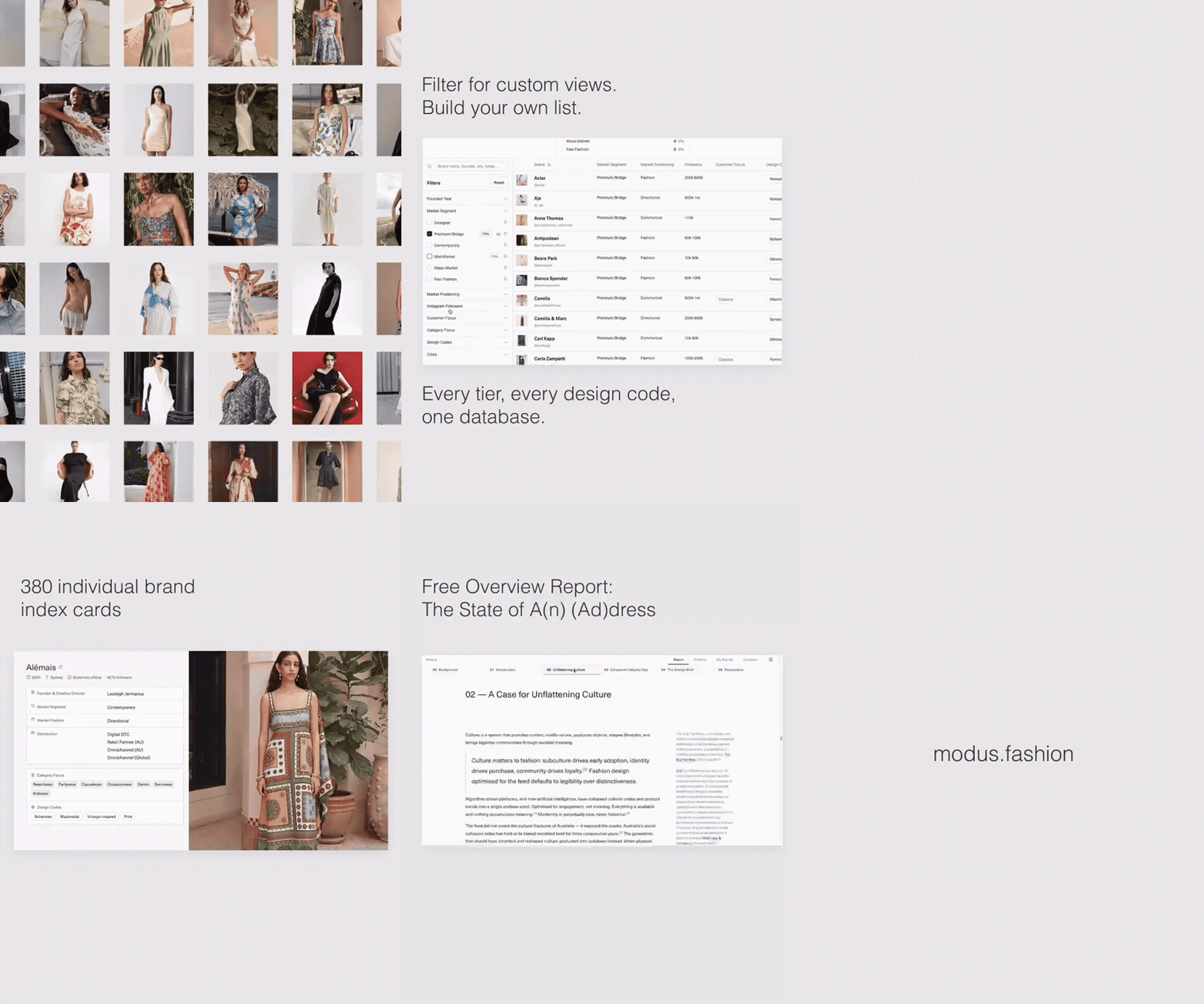
I wrote this in collaboration with Kayla Marci of Haute Garbage, a trend analyst, forecaster and writer whose background spans EDITED and her own Substack, where the research is rigorous and the point of view is entirely her own. She also reviewed Australian Fashion Week via trend report which just happened last week. Check it out here.
I’m still exploring trends and concepts at a wider scale but recently returned to Sydney and dove into the local market. This work is a direct result of reacquainting myself with where I live, after a decade away, and happily learning there is much more than the linen sack dress, and boho-chic is mostly outdated. Paid subscriptions are paused for now. More to come.
Contents
Femininity and Trend Loops
Femininity is not a creative position. It is the very soul of womenswear and its default condition, its qualities revisited, reimagined, and marketed with every brand, season, or new cultural composition. What has shifted is its range.
Micro-trends and trend hybridization have made femininity more elastic. Newer expressions of femininity range from slinky jersey separates (a la Paloma Wool) that define an Alternative Femininity or Sensuality, to a heavily nostalgic, romanticised Girlhood. These pillars bookend a contemporary essentialism middle that is the residue of quiet luxury, normcore, and minimalism collapsed into one. It’s something that is simply understood as commercially adult but still feminine through its palette of soft neutrals or cocooning utilitarianism for its wearer. Vanessa Friedman named this register Adult Desire – a womenswear sensibility that is not exactly minimal, not overtly sensual, but carries the suggestion of both through the need of practicality and expression.
These desires are not new and can be seen as universal truths of what women want, or what womenswear needs, stretching applications of femininity to suit us in our time and place, or our own divine feminine ideals.
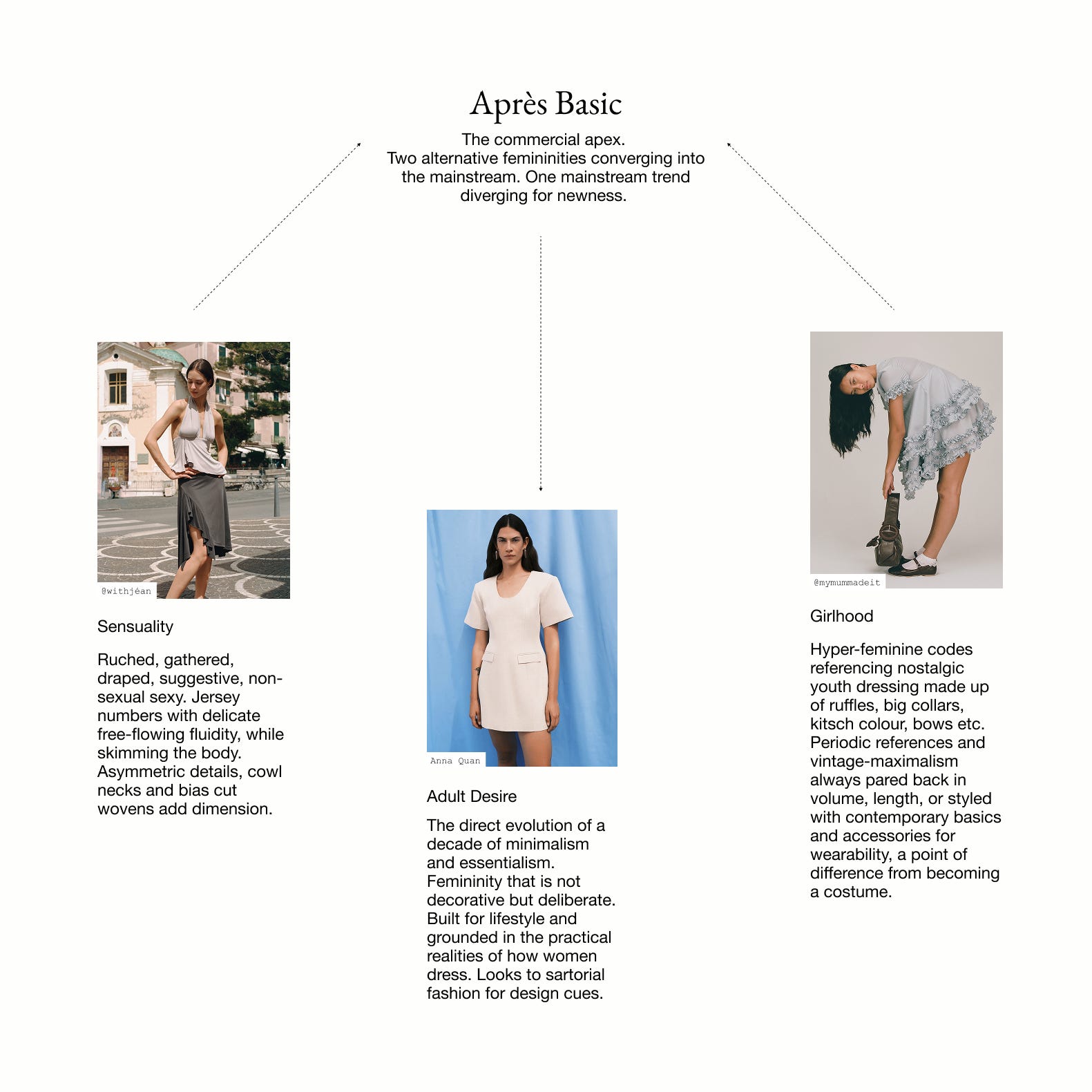
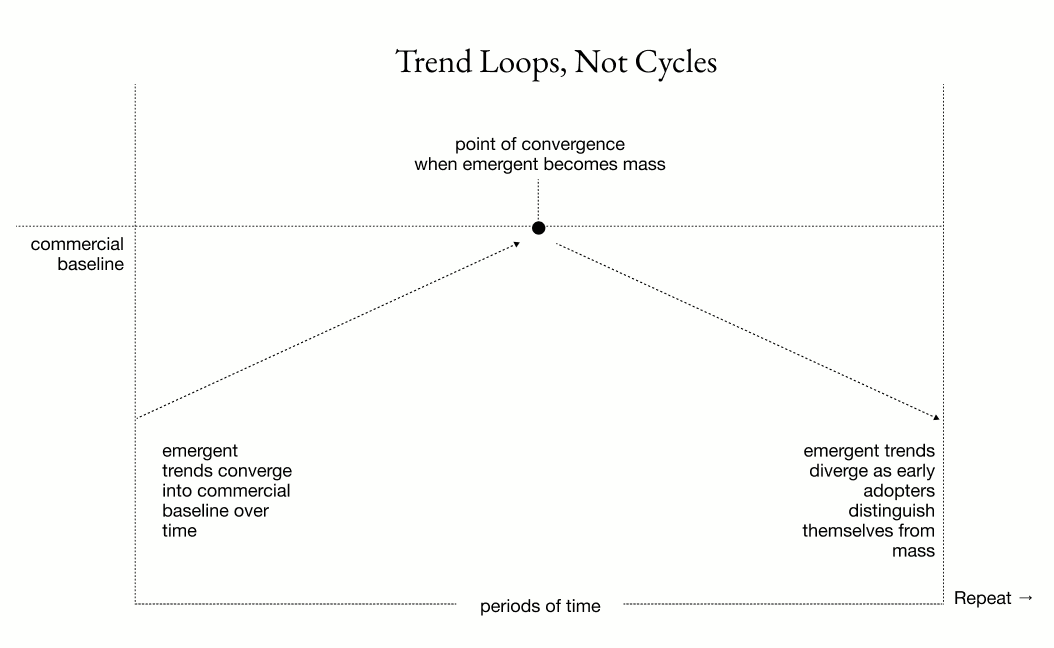
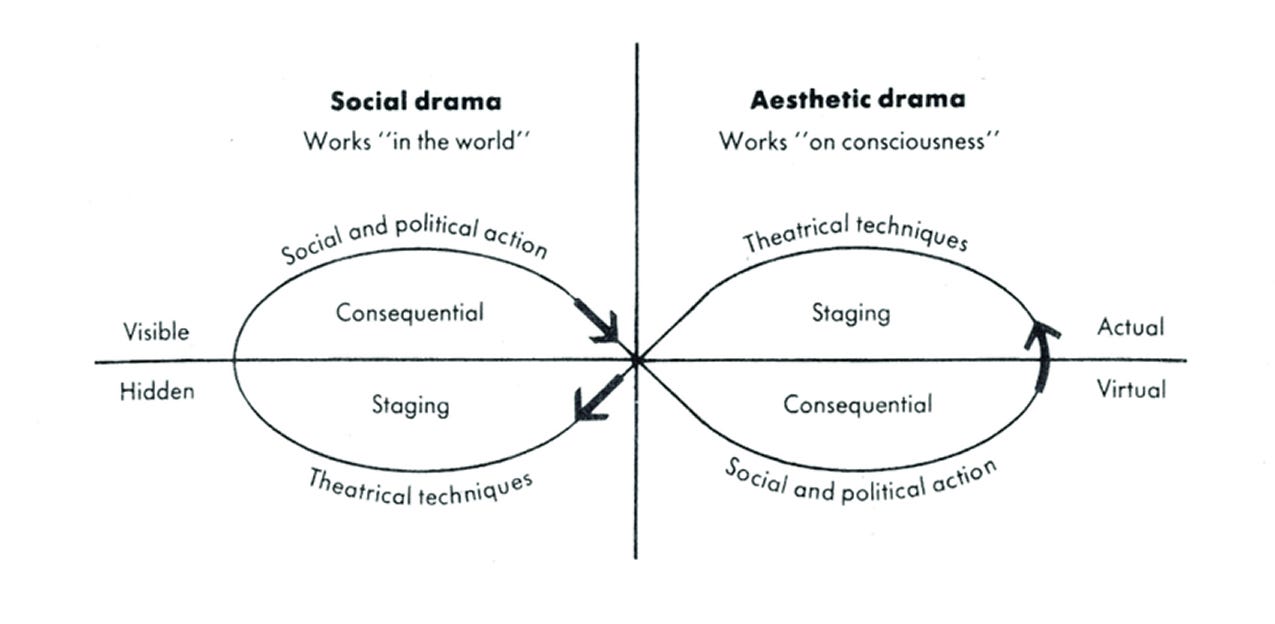
A little left of center but relevant, the below graphic about the loop of audience expansion by Itay Dreyfus was straightforward and applicable to how trends, in this endless age of yearning for the past, keep coming back. It’s no longer a cycle, but a series of loops.
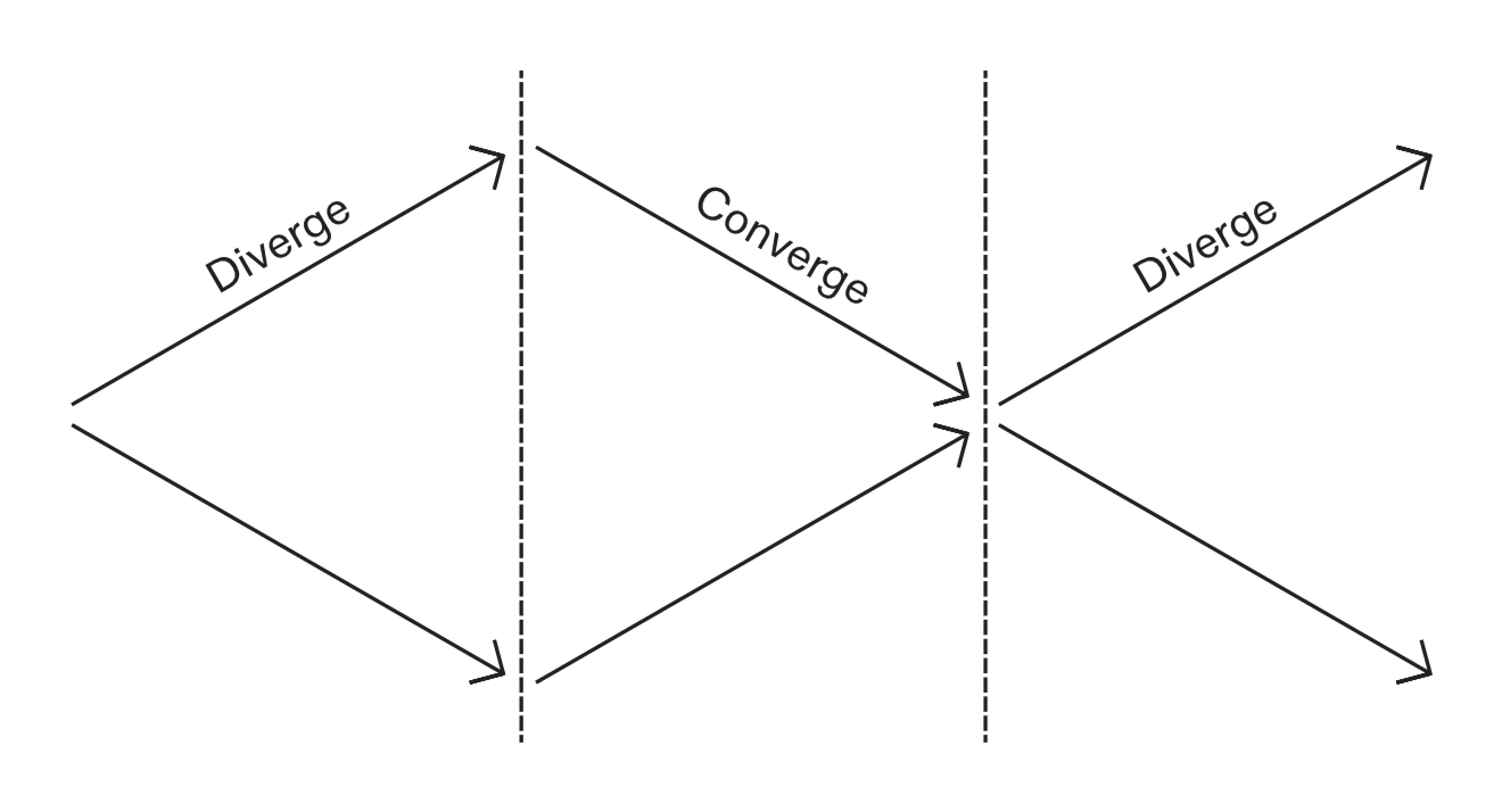
Haute Femininity? by Kayla Marci
I asked fellow ex-expat and Melbourne-based Kayla Marci of Haute Garbage on how she sees femininity in fashion, especially as someone who is looking at both global and local contexts at the same time:
Femininity within fashion is a complex and often paradoxical subject. Women make up just 12% of creative directors in luxury fashion, meaning that an eye-watering proportion of the designs presented as “feminine” are typically skewed through a male lens.
Yet, despite the industry over-indexing in male talent, brands helmed by women are scoring points with the fashion crowd. The romantic bohemian of Chemena Kamali’s Chloé, the unapologetic coolness and soft quirk of Prada and Miu Miu, the hyper-femininity of Sandy Liang, or Phoebe Philo’s effortlessly modern approach to minimalism.
Within the mass market, the excessive overload of micro trends and aesthetics has flattened several of these designers’ codes and our perception of feminine dressing into tropes. The Coquette, The Office Siren, The Tradwife, The Cool Girl, and so on, dilute self-expression into starter packs spearheaded by tastemakers that often uphold societal beauty standards.
Consumers have felt the pressure to digitally signal the women they want to be in the moment instead of curating items over time to reflect a more layered, authentic sense of self, leading to the fatigue of algorithmic dressing and heightening the desire to reboot and redefine personal style.
Emerging instead is a shift toward design-led, rather than marketing-driven, approaches to unflatten femininity and reflect the complex realities of being a woman in an unstable cultural and political climate.
Beyond a global context of perma-crisis, household names, and digital micro-trends, a select group of Australian brands are cutting through the noise. Brands such as St. Agni, Friends with Frank, Ngali, Deiji Studios and Mode Mischief have gained cult followings online for their own takes of femininity ranging from minimalist to eclectic through design, not just messaging. Additionally, Australian brands are challenging geographical clichés in favor of femininity with a point of view. For instance, Queensland brands With Jéan and My Mum Made It, lean into youth-driven cultural trends and lifestyles that result in a contemporary sensuality and a girlhood-coded femininity, contrasting with the cookie-cutter resortwear typically associated with the region.
Given the various ways consumers perceive femininity, it’s up to brands to understand and deliver what their consumers desire and recalibrate to create products for our future selves, rather than catering to the instant gratification of digital culture.
OzModus: Global Fashion v. Aussie Fashion
The osmosis is complete. Global trend pillars have moved through local style identities at a pace the internet made inevitable. Which means newness in Australia is not from a local luxury house (they don’t exist here) and directional designer brands are few.
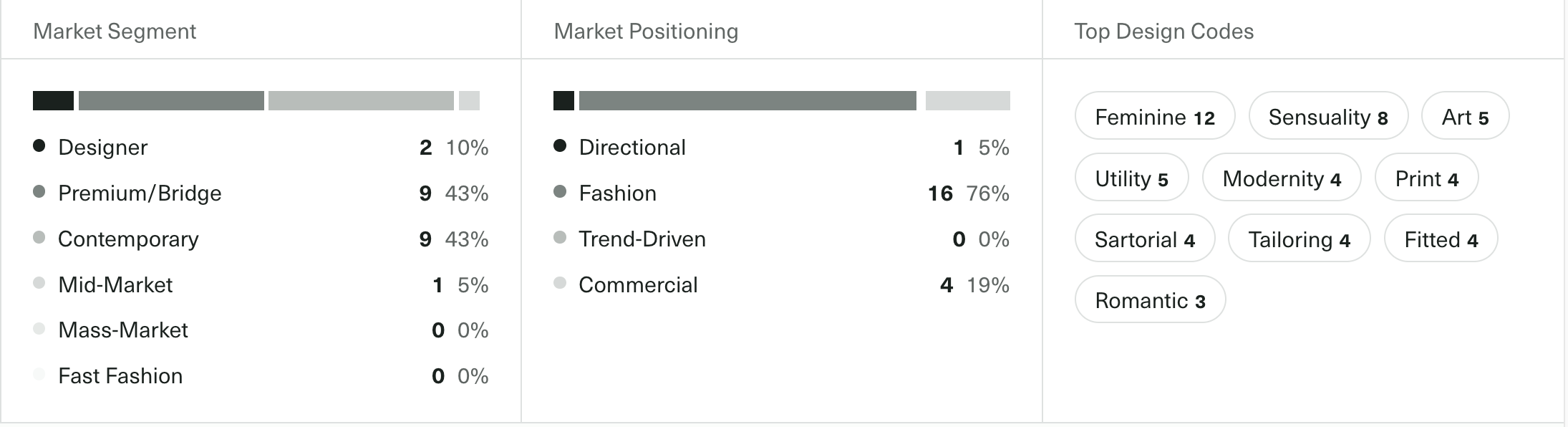
While global attention turned to the Chanel, Dior, and Gucci cruise circuits last week, Australian Fashion Week ran semi-concurrently in Sydney. Small by any global measure, and a fraction of the market Modus mapped. Of the 36 brands on the schedule, 21 met the basic criteria for the Modus framework: a website, enough dress SKUs to assess. What that sample returned was Fashion-positioned, Premium/Bridge and Contemporary-concentrated, with 0% Trend-Driven representation (a good thing). AFW was not quite a demonstration of the Australian consumer’s most engaged or commercially aspirational brands. It was a curation of a sort, a championing of a selective industry.
Newness, then, is found somewhere else entirely: in the distance between where commercial womenswear is now and what a brand targeting a younger market is reaching for in arenas outside fashion week, year round.
Young Women’s/Youth is the arena much of trend forecasting targets, though it is no longer strictly age-based. Generally it ranges from 18-25, though this has become more expansive for the spiritually Gen-Z. Brands targeting this audience build in alignment with cultural cues from online culture rather than serve a designer or brand’s singular vision. These brands are also typically produced at speed to keep up with algorithms and attention spans.
To understand where that distance sits, the design identities of the 380 brands were mapped across multiple design codes, manually.* A clear divergence emerged: brands tagged with a YW/Youth customer focus showed markedly higher penetration across codes the wider womenswear market barely registers.
*Design code assignment is subjective by nature. All 380 brands were reviewed and tagged by hand.
The Modus data attached percentages to what any industry observer already suspected from scrolling or simply stepping outside. Design codes are not trend language. They are the creative directives that result in a garment itself, not the stylised version of it.
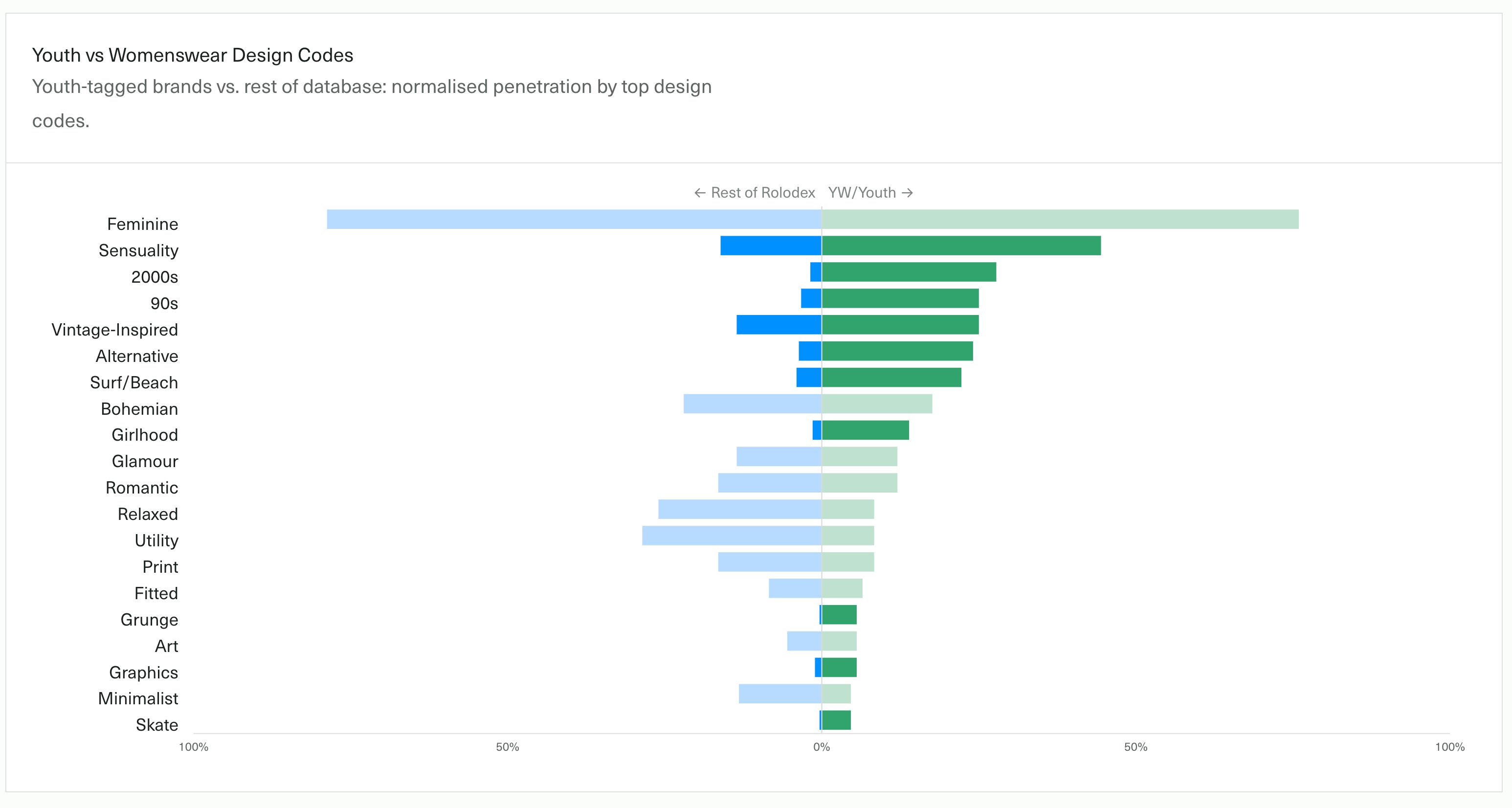
The top three codes diverging toward youth: Sensuality (48 brands, 44.4% vs 16.2%), 2000s (30 brands, 27.8% vs 1.8%), Alternative (26 brands, 24.1% vs 3.7%). Where the broader market holds its ground: Utility (77 brands, 28.3% vs 8.3%), Relaxed (71 brands, 26.1% vs 8.3%), Romantic (45 brands, 16.5% vs 12.0%).
Two futures sit at the end of this divergence. In one, the alternative audience ages into the commercially dominant group: relaxed silhouettes, utilitarian details, fabrics that hold the outline of what the garment means in the lifestyles of women, rather than any structural, fashion intention. In the other, commercial brands cede a percentage of their design direction toward trend-leading audiences, recognising that early adopters (YW/Youth) are not a niche but a signal, the reference point from which the next collection borrows.
This divergence and probable convergence is a pattern familiar to anyone watching trends closely. It is also where the more interesting version of Australian fashion is being made. Australian fashion shares the same design language as its global counterparts and has the audience appetite to close that distance. The data shows where the gap is. What happens next is a design decision before anything else.
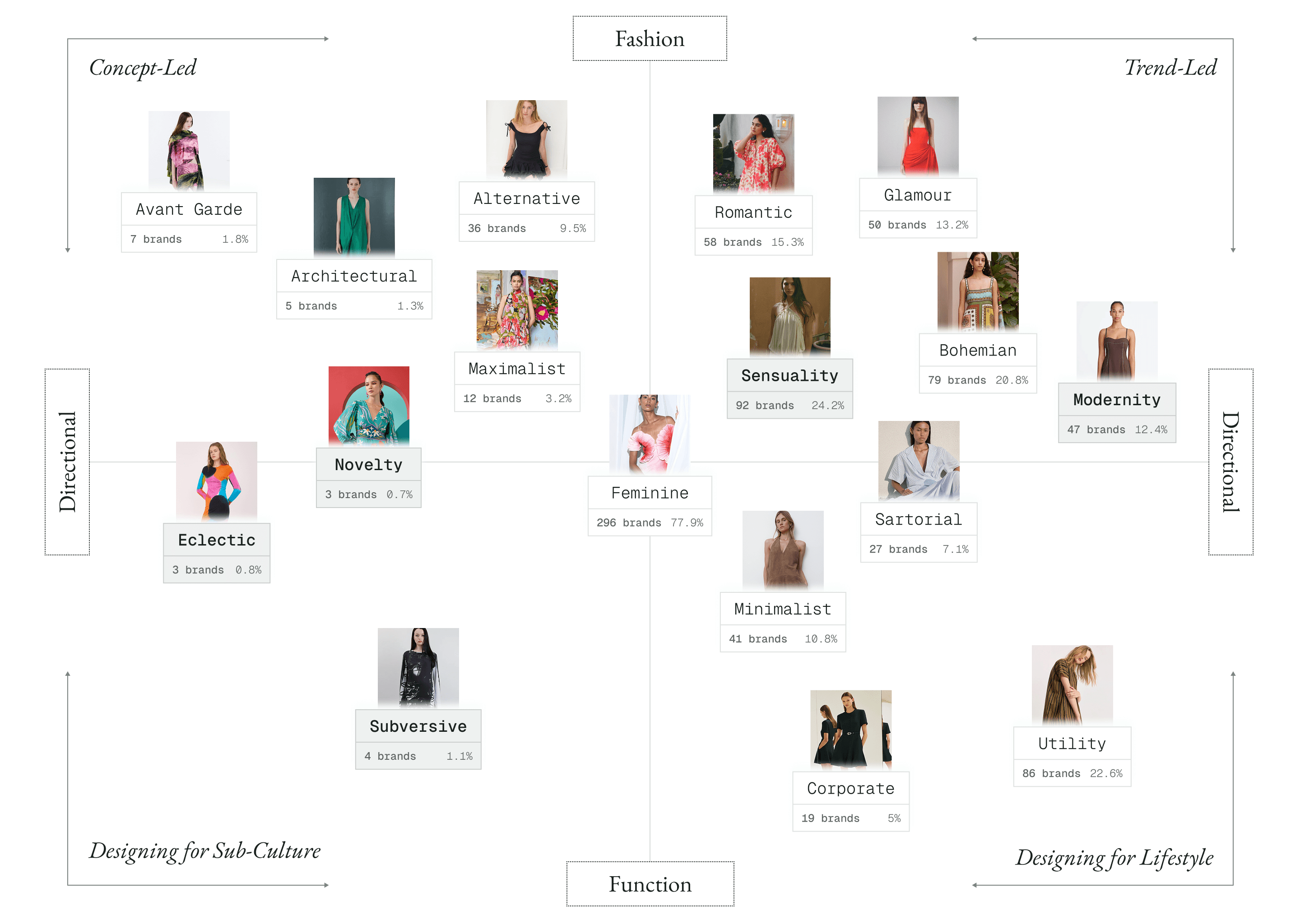
The full report is at modus.fashion. Big thanks to Kayla Marci for her collaboration and for being one of the first users of Modus – it would not have taken its shape without her expertise.
I’m sharing free access codes to the Modus Rolodex for a limited time DM me for a code. If you are in Aus or Aus Fashion adjacent I’d love to hear what you think about Aus fashion too!
Required reading:

Additional reading:
Looking to tech and product design has become increasingly important in this digital world especially since all of our output ends up on the same feed. Growth Pains by Itay Dreyfus
The cluster of House of Sunny/Avant Basic, Ganni, Damson Madder, Lisa Says Gah might be an era-defining strain of femininity. where have all the ganni girls gone? by Viv Chen is the perfect observation of it.
Make Australia Ambitious Again by Rolodex Media sets the scene of Oz beyond fashion.
 | A guest post by
|